


















-
 Tomas Augustis
 -
19 agosto 202612 min. lettura
The 81st edition of the Vuelta a España kicks off on August 22 with a nine-kilometer time trial through the streets of Monaco and won’t be decided until the final weekend in the Sierra Nevada. Three weeks, nine mountain finishes, and a route that gets tougher just as the race reaches Andalusia leave plenty of room for the overall lead to change hands right up to the final mountain stage.
Tadej Pogačar arrives as the runaway favorite off the back of a fifth Tour de France title, but a stacked chasing pack and a brutal final week mean the race for the podium — and the minor jerseys — is wide open.
In this analysis we review the odds for the red jersey, highlight the stages where the real gaps will open up, and offer the bets we see as having the most value before the race starts. Futures carry the best odds right now but tighten fast once the race is underway, so the time to bet is before Monaco.
Indice dei contenuti
- 2026 Vuelta a España Winner Prediction: Our Favorite
- Odds and Favorites for the Red Jersey
- Spanish and Latin American Riders to Watch
- The Stages That Will Decide the General Classification: Andorra, Aitana, and Sierra Nevada
- The Jerez Time Trial: The Turning Point of the Third Week
- Green Jersey and King of the Mountains Jersey Predictions
- Value Bets: Underdogs With a Favorable Course
2026 Vuelta a España Winner Prediction: Our Favorite
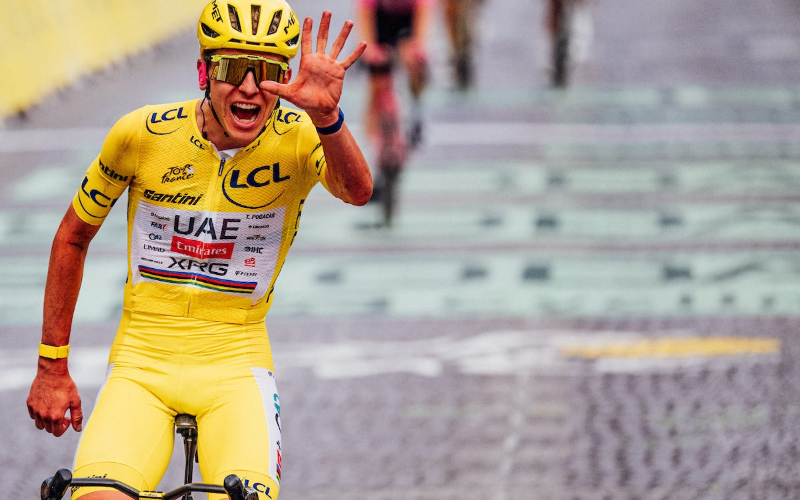
There isn’t much suspense at the top of the market. Tadej Pogačar is priced at 1.10 across the major boards, and every piece of evidence points the same direction: he arrives having won a fifth Tour de France, and his participation is officially confirmed by UAE Team Emirates-XRG.
He brings the strongest support squad in the race — João Almeida, Jay Vine, Pavel Sivakov, Kevin Vermaerke, Ivo Oliveira, Domen Novak, and Spanish rider Pablo Torres, who gets a rare start alongside the sport’s dominant favorite.
Pogačar has ridden the Vuelta only once before, in 2019, finishing third overall behind Primož Roglič and Alejandro Valverde with three stage wins as a 20-year-old. Should he win this year, he becomes only the ninth male rider in history to complete the full set of Grand Tour titles — and only the second active rider, alongside Roglič, to have won all three.
The only genuine question is fatigue, and it’s the one thing the market is structurally bad at pricing. A price of 1.10 reflects everything measurable — Tour form, time-trial power, squad strength, tactical range — and almost nothing about how a body responds to a second Grand Tour in a compressed summer, with a World Championship still on the calendar behind it.
The Vuelta starts less than four weeks after the Tour finished, and Pogačar is also targeting Montreal two weeks after the Vuelta ends, which leaves no real off-season between the two.
If he arrives fresh, the Sierra Nevada on stage 20 becomes a coronation and the rest of the field is racing for second. If he doesn’t, the challengers are already positioned to take advantage: Almeida is inside the same team car, Gall has a Giro podium in his legs, Carapaz has already stood on this exact Vuelta podium once before, and Roglič has won this race four times when nobody was quite sure he was ready.
Three weeks from Monaco to Granada is a long time to hold a 1.10 price — and the organisers have made sure the hardest climb of all arrives on the second-to-last day.
Odds and Favorites for the Red Jersey
Behind the runaway favorite, the market splits into clear tiers. One note before the numbers: Florian Lipowitz is not in this race. He fractured his right collarbone crashing in the stage 16 time trial at the Tour de France and was ruled out for a minimum of six weeks — his name is still showing up priced around 15.00 on some boards, but that’s stale.
Also worth flagging for Latin American readers: Nairo Quintana was left out of Movistar’s selection. The 2016 Vuelta champion, now in his final professional season, will not start — a notable absence from a rider who remains one of the most popular figures in Colombian cycling.
The favorite
Tadej Pogačar (UAE Team Emirates-XRG) — 1.10
Direct challengers
Felix Gall (Decathlon CMA CGM) — 13.00. Second overall at the 2026 Giro d’Italia, then a Vuelta a Burgos overall win in his final tune-up race.
João Almeida (UAE Team Emirates-XRG) — 15.00. Last year’s runner-up and stage winner on the Angliru, riding this year with the tactical freedom to inherit leadership if anything happens to Pogačar.
Oscar Onley (Netcompany INEOS) — 17.00. Won stage 2 of the Vuelta a Burgos in a straight uphill sprint and finished second overall.
Richard Carapaz (EF Education-EasyPost) — 21.00. Reigning Tour de France King of the Mountains, already a Vuelta runner-up in 2020, with the GC podium as this team’s explicit target.
Enric Mas (Movistar) — 21.00. Fifth overall at Burgos, racing on home roads with six top-six Vuelta finishes.
High-level outsiders
Primož Roglič (Red Bull-BORA-hansgrohe) — 26.00. A four-time Vuelta champion whose preparation was interrupted by a training accident that cost him San Sebastián and Burgos.
Mattias Skjelmose (Lidl-Trek) — 34.00. Sixth overall at this year’s Tour de France.
Spanish and Latin American Riders to Watch
There’s more happening below the top of the market than the outright odds suggest, and a good chunk of it involves home-soil names.
Enric Mas (Movistar, Spain) is the highest-profile Spaniard in the peloton and the closest thing this race has to a designated home favorite. Six top-six Vuelta finishes, including three runner-up spots and a third place, make him a Vuelta specialist even in seasons when his form elsewhere has been quiet.
He shares leadership at Movistar with Cian Uijtdebroeks, and the team has built a genuinely strong Spanish supporting cast around them: Pablo Castrillo, a two-time Vuelta stage winner in 2024, plus Iván Romeo, Raúl García Pierna, Carlos Canal, and Jorge Arcas.
Carlos Rodríguez (Netcompany INEOS, Spain) is quietly one of the most underrated GC riders in the field. He has finished top-ten at the Tour de France before, and after being left out of this year’s Tour squad, he arrives in Spain without the accumulated fatigue several rivals are carrying. With Onley alongside him, INEOS effectively has two GC cards to play.
Pablo Torres (UAE Team Emirates-XRG, Spain) rides directly in support of Pogačar on the strongest team in the race — a rare opportunity for a Spanish rider to be inside the winning car from day one, even in a support role.
Jesús Herrada (Burgos Burpellet BH, Spain) leads the Spanish ProTeam into his eighth Vuelta appearance chasing a first stage win in Burgos colours, having already won three Vuelta stages earlier in his career.
Sergio Samitier (Cofidis, Spain), Urko Berrade (Equipo Kern Pharma, Spain), and Cristián Rodríguez (XDS Astana, Spain) round out the list of Spanish climbers who will be looking for breakaway opportunities across the three weeks, particularly on the medium-mountain stages where the GC teams are less likely to chase.
Three names carry particular weight across Latin America. Richard Carapaz (Ecuador, EF Education-EasyPost) is the biggest storyline outside the Pogačar conversation — reigning Tour de France King of the Mountains, former Giro d’Italia champion, and a rider with genuine GC podium credentials on this course.
Iván Sosa (Colombia, Equipo Kern Pharma), a two-time Vuelta a Burgos winner and former Ineos and Movistar rider, leads the most experienced Grand Tour squad among the Spanish ProTeams. And Harold Tejada (Colombia, XDS Astana) is enjoying arguably the best season of his career, having finished 12th overall at last year’s Vuelta while flying under the radar.
The Stages That Will Decide the General Classification: Andorra, Aitana, and Sierra Nevada
Three moments do most of the damage on this route.
Stage 4 — Andorra. 104.8km with 2,953m of elevation gain and a downhill finish, this is where the GC picture can crack open before anyone has properly settled into the race. Riders who arrive underprepared will already be defending a deficit by the first rest day.
Stage 9 — Alto de Aitana. 187.4km with 5,166m of climbing and a 22km final ascent averaging 5.8%, finishing on a summit exposed to late-August heat. This is the first stage where the debutants — Uijtdebroeks, Nordhagen, Widar — either prove they belong in the GC conversation or don’t.
The Andalusian block that follows — Calar Alto on stage 12 and Sierra de la Pandera on stage 14 — keeps grinding away at anyone who survives Aitana with a fragile lead.
Stage 20 — through the Sierra Nevada to Collado del Alguacil. 186.8km with 4,890m of climbing and an 8km final climb averaging 8.9% — the race’s only Categoría Especial ascent, arriving on the penultimate day. This is the stage the intro refers to when it says the race won’t be decided until the final weekend in the Sierra Nevada: with the finish this steep, this late, and this close to Granada, no GC lead is genuinely safe until the summit.
Stage 19 to Peñas Blancas, one day earlier, sets up exactly the kind of accumulated fatigue that makes the Alguacil so dangerous.
The Jerez Time Trial: The Turning Point of the Third Week
Stage 18 — 32.1km, flat, along the coast to Jerez de la Frontera — is the single stage that separates the winner-shaped riders from the climber-shaped ones. It arrives with only three days left before Granada, which means whatever happens here is very hard to reverse. This is exactly the kind of terrain where betting on mountain stages versus time trials requires a different read on form than the summit finishes do.
For Pogačar, this is close to a free hit: a rider who climbs with the best and then takes real time on a flat, wind-exposed time trial has a structural advantage no tactic can defend against. For Gall and Roglič, it’s the opposite — both need to arrive in Jerez with a buffer built in the mountains, because both are expected to lose time here, not gain it.
Among the Spanish and Latin American contingent, Iván Romeo (Movistar) is the rider best placed to target the stage itself, having made his Vuelta debut with both time trials flagged as personal objectives.
Green Jersey and King of the Mountains Jersey Predictions
Both secondary classifications look genuinely open this year, and both have real depth behind the headline names.
Green jersey (points classification). With relatively few straightforward sprint stages on this route, the points battle should suit versatile riders as much as pure fast men. Debutant Matthew Brennan (Visma-Lease a Bike) is the market favorite at the shortest odds, just ahead of defending champion Mads Pedersen (Lidl-Trek), with Tadej Pogačar and Wout van Aert close behind.
Pedersen is the defending champion and also won the classification in 2022, having just completed the Tour de France with another green jersey — only the sixth rider in history to win the points classification at all three Grand Tours. Brennan’s shorter price reflects genuine sprint speed on a Vuelta debut, backed by two wins at the Vuelta a Burgos in early August.
Prediction: Mads Pedersen to win the points (green) classification at odds of @3.50.
King of the Mountains (polka dot jersey). The market’s actual favorite here may surprise: it’s Pogačar, not a climbing specialist, priced around @3.00, ahead of Lorenzo Fortunato (XDS Astana) at 6.00–6.50, Richard Carapaz (EF Education-EasyPost) at 6.50–7.00, and Jay Vine (UAE Team Emirates-XRG) at 7.00–7.50.
That pricing reflects Pogačar’s sheer frequency of stage wins on summit finishes rather than a dedicated points campaign. Among the specialists, Carapaz is still the strongest form case: he’s the reigning Tour de France King of the Mountains and already won this exact Vuelta jersey in 2022.
Fortunato, who won the Giro d’Italia mountains classification in 2025 by a huge margin, is priced as the value alternative. Further down the board, Valentin Paret-Peintre sits at 10.00–11.00 and Primož Roglič — an unconventional KOM pick given his GC ambitions — is priced at 15.00–17.00.
Prediction: Lorenzo Fortunato to win the King of the Mountains classification at odds of @6.50.
Value Bets: Underdogs With a Favorable Course
This is where the Vuelta gets interesting. Behind the top tiers sits a genuine cluster of riders whose current form outstrips their price — including several Spanish and Latin American names. These are the kind of picks that reward digging into cycling betting markets beyond just the outright favorite.
Sepp Kuss knows how to survive three weeks in Spain better than almost anyone in the current peloton. He has spent years working as a super domestique at the highest level of Grand Tour racing, and that experience translates directly into pacing and climbing efficiency over 21 stages.
Prediction: Sepp Kuss to finish inside the top 10 at odds of @1.83.
His role this year gives him freedom that past seasons often did not. Without the same GC pressure some rivals carry, Kuss can ride a smarter race and pick his moments on the toughest climbs. That patience usually pays off exactly when the race gets hardest in the final week.
Matthew Riccitello won the young rider classification at last year’s Vuelta while finishing fifth overall, the best Grand Tour result of his career. That breakthrough earned him a three-year move to Decathlon CMA CGM, and he arrives in Spain knowing exactly what it takes to win this competition.
Prediction: Riccitello to win the young rider classification at odds of @6.00.
His climbing credentials back up the price. Riccitello finished fifth overall at the 2024 Tour de Suisse and won the Sibiu Cycling Tour in 2025, building a reputation as one of the peloton’s most reliable young climbers.
His Tour de France debut this July was rougher, finishing 24th overall, but the Vuelta was always the real target on his calendar. Rivals like Cian Uijtdebroeks and Oscar Onley bring real threats, yet neither has Riccitello’s track record on this exact course.
Defending a title tends to carry weight when the climbs get steep in week three.
Carlos Rodríguez (Netcompany INEOS, Spain) arrives with essentially no accumulated fatigue after missing the Tour de France, and a genuine chance to remind people why he was once considered the heir to Enric Mas and Mikel Landa as Spain’s next Grand Tour leader.
Prediction: Carlos Rodríguez to finish inside the top 10 at odds of @1.83.
Cristián Rodríguez (XDS Astana, Spain) and Harold Tejada (XDS Astana, Colombia) give the same team two live top-10 markets. Cristián has already finished 13th at the Vuelta twice, and Tejada is enjoying arguably the best season of his career after finishing runner-up to Mauro Schmid in a two-up breakaway sprint on stage 13 of the Tour de France.
Jørgen Nordhagen is the value play inside a Visma-Lease a Bike team that, unusually, arrives without an established GC leader — Vingegaard is absent and the closest thing to a protected climber is Nordhagen himself, off the back of fourth overall at the Tour de Romandie.
Prediction: Jørgen Nordhagen to finish inside the top 10 at odds of @1.65.
Odds on this race move quickly once final startlists are confirmed and early stages establish who’s actually riding well — the Lipowitz and Quintana situations above are a reminder that boards can go stale fast. It’s worth checking a full rundown of sports betting operators to find the most competitive prices.
As always: bet only what you can afford to lose, and treat any odds quoted here as a snapshot taken before the start in Monaco rather than a guarantee of what you’ll find on race day.
Scopri gli altri pronostici qui.
Questo pronostico è solo indicativo. Non siamo responsabili delle vostre scommesse.
Articoli consigliati

Tomas Augustis
Analista sportivo
Notizie sulle scommesse